Showing posts with label sallis. Show all posts

Sunday, November 20, 2016

JAMES SALLIS' DRIVE: THE GRAPHIC NOVEL

This graphic adaptation of James Sallis's great novella seems to take its cue in part from the Nicolas Winding Refn movie adaptation, with its neon-infused, 80's nostalgia vibe. One of the first things I noticed in the graphic novel was the color, the magenta and green tones really evoked a similar mood to the movie.


The book, which collects the four comic issues of Drive, pares Sallis's book down to the bare essentials, which isn't always a good thing, especially because a Sallis book is most likely already just bare essentials. Although it keeps the ultra-hard-boiled vibe and some of Sallis's best lines, it loses much of the thoughtfulness and idiosyncrasies that are some of the trademarks of a Sallis book. Also, the abbreviated comic book structure causes it all to seem like a rush, skimming over important elements, like Irina and Benicio, and the Driver's past. This adaptation isn't bad, just not very memorable.

GRADE: C+

Tuesday, August 25, 2015

GHOST OF THE FLEA by James Sallis

* Book 6 of the Lew Griffin series *

And finally we get to the grand finale of James Sallis's atypical, challenging, and elusive Lew Griffin
series. This novel has solidified the feeling that all six books are just part of one large story, a singular investigation into Lew Griffin's own life and purpose. No single book in the series can stand on its own without the others surrounding it. These novels probably shouldn't even be considered crime fiction, but if they are, they should definitely be seen collectively as one of the bravest pieces of crime fiction out there. I believe that not only was Sallis painting us a portrait of a complex man named Lew Griffin, but he was also painting a portrait of himself as a writer, with details for us to discover, or as he puts it many times in his books: he was sending us messages in code. Sallis is a superb writer, and this book is possibly the most impressive in the series in regards to pure prose. Sallis also provides a wonderful conclusion to the series, with a tone that fits perfectly in with the rest of the novels. But I want this review and the 5-star rating to not refer to this book alone, but to show big love to the series as a whole. These six novels might not be for everyone, and can be demanding and at times frustrating, but by its end, you'll know you experienced something special.
Out there in the window-world where a moth beat against glass, a man I knew both too well and not at all stood watching. A man dark and ill-defined, with the mark of lateness, of the autumnal, upon him too.
GRADE: A


Sunday, July 26, 2015

BLUEBOTTLE by James Sallis

* Book 5 of the Lew Griffin series *
That's what we're here for, Griffin. To bear witness, to
take notice. Ever doubt that, you just look into a child's eyes.
When jumping into a book by James Sallis, especially the ones in the Lew Griffin series, I've learned not to expect that he'll be interested in focusing very much on plot. I don't read them for action, but I do read them for Sallis's evocative writing, and for the characters themselves. I've mentioned before that one of the most fascinating things about the Griffin series is the malleable chronology, the blurring of history and the parallels (which essayist Richard Martin calls "echoes) in Lew's life. In Bluebottle, the fifth and penultimate novel in the series, time is at it's most malleable here than in any of the previous books as Lew remembers a time in the seventies, after he was shot and lost a year of his life and memory, and the subsequent search for the white woman he was with at the time of the shooting. 
Chekhov insists that once a story is written we cross out the end and beginning, since that's where we do most of our lying. What you have here, then, is all middle: all back and fill, my effort to reconstruct the year missing from my life, to hold on to it.
Sallis jumps back and forth and up and down through time as Lew recalls various aspects throughout his life, but it never felt too confusing. And there are many echoes of characters and situations from other parts of Lew's narrative, and sometimes it causes you to either doubt Lew's memory, or wonder at the significance. For example, the woman he's searching for, Dana Esmay, is eerily similar to Esmé Dupuy, the white journalist who was with Lew during the shooting in Black Hornet that is almost a straight parallel to the one here. There are more examples of this throughout all of these books and it makes for fascinating reading. There are some interesting plot elements this time around, like the missing writer that Lew ends up searching for, a man who begins to write his masterpiece by researching a white supremacist group, and might have ultimately began to commit fully to their cause.
I never found out exactly what it was that had hurt my friend so–something working in him a long time, that finally found purchase. In future years I'd come to recognize similar things scrabbling for footholds within myself. They were already there, of course, even then. Sometimes at night I heard them breathing.
GRADE: B

Monday, June 8, 2015

EYE OF THE CRICKET by James Sallis


GRADE: B-

*Book 4 of the Lew Griffin series*

James Sallis's books are usually pretty short so you'd think I would be blazing through them. But they're so densely written and realized that it forces you to take your time while reading. This one is probably the densest of the existential Lew Griffin detective series so far. In this, the 4th book, we return back to the 90's section of Lew's life (so essentially a sequel to book 2, Moth), where Lew is not only searching for the missing brother of one of his students, but also is struggling with the sudden appearance of his doppelganger, a homeless man claiming to be him, and what it could mean in the search for his own long lost son.

I had the hardest time reading this book out of the other Griffin novels, as it felt more uneven and unfocused than the others, and it was difficult to get  a grasp at what was going on and what it all meant. I did like how this installment found Lew really trying to atone for many things that he regrets in his past, trying to make things right in so many ways. But don't start with this one. You shouldn't start with this anyway because it is absolutely necessary that this series be read in order, as it demands full attention of the reader across books to recall characters and situations, and the enjoyment of the novels are based on a frame of reference created by the previous ones. The series itself is a rich experience but this volume is the most maddening...

Thursday, April 2, 2015

DRIVE by James Sallis


GRADE: B+

*Re-Read in 2015 (originally read in May 2011)*
I've been on sort of a casual James Sallis binge lately, so I decided to squeeze in a re-read of the first book I read by him. I liked it a lot more this time, which might be due to the fact that I'm more familiar with his writing, or I'm in just a different mindset. In Drive, Sallis tries his hand at a hard-boiled, Parker-style heist story. And while being true to all the conventions of the genre, he still infuses it with his own trademark style: minimalist but effective prose, a non-linear structure, and HEAVY emphasis on character over plot development. 

Our main man (only known as Driver) is a skilled stunt driver for the movies by day and still manages to hold a part-time job as a wheelman for thieves. As with Sallis's other work, this is more of a character portrait, and Driver is definitely an intriguing character, tough but still private and introspective.  He wouldn't hesitate in stabbing a hard-ass in the throat, but also wouldn't hesitate to walk to a local payphone and call a screenwriter friend whenever he needs help understanding a difficult word he reads in the used paperbacks he buys at the cut-rate store. And the book also has an awesome first chapter, and one of my favorite opening paragraphs in fiction:
Much later, as he sat with his back against an inside wall of a Motel 6 just north of Phoenix, watching the pool of blood lap toward him, Driver would wonder whether he had made a terrible mistake. Later still, of course, there'd be no doubt. But for now Driver is, as they say, in the moment. And the moment includes this blood lapping toward him, the pressure of dawn's late light at windows and door, traffic sounds from the interstate nearby, the sound of someone weeping in the next room.

Thursday, March 5, 2015

BLACK HORNET by James Sallis


GRADE: B+

*Book 3 in the Lew Griffin series*

With Black Hornet, I'm realizing that the Lew Griffin series is entirely the written memories of an older man looking back on and contemplating major events in his life. While the first novel, The Long-Legged Fly, jumps around in time to study a changing man through different decades and the second novel, Moth, expands more on the 1990's part of his life, in Black Hornet, Lew remembers more events from the 1960's, expanding on the first part of Fly. What struck me, was how much the book actually did feel like a memory, even more so than the previous stories. Lew's narration seems to be unstuck in time, paralleling the past and present, cross-referencing not only things that have happened, but events to come and filling in some of the blanks between events that we are aware of from the previous books (maybe this is material for the later novels in the series?). All of this gives a great sense of an old man looking back on life with waning memory.

This story focuses on the younger Lew of the 1960's section of Fly, a raging drinker and debt collector, who is still far away from the best-selling novelist, professor, and sometime private detective that we know from the 1990's. He meets Esmé Dupuy in a bar, a white journalist who he has a drink with but who is soon gunned down right in front of him, the latest victim of a sniper that's been terrorizing New Orleans shooting white people. Lew is set on tracking the man down. And in doing so, we get to witness how Lew meets different people that we know will be important friends in the times to come.

This book has a very different atmosphere from the previous books in the series. There's more of a focus on race and racial identity and protest, probably coming out of being set in the racially-charged and political '60's. Lew finds himself adrift in this world, bumping into militant groups like the Panthers, and even meeting and rubbing shoulders with a socially-angry Chester Himes at an event for the author, a scene that turns out to be a great homage to one of Sallis's inspirations. Although the book is pretty short, I took my time with it and soaked in Sallis's passionate prose, enjoying yet another great book in a series focusing on identity and memory.

Tuesday, February 17, 2015

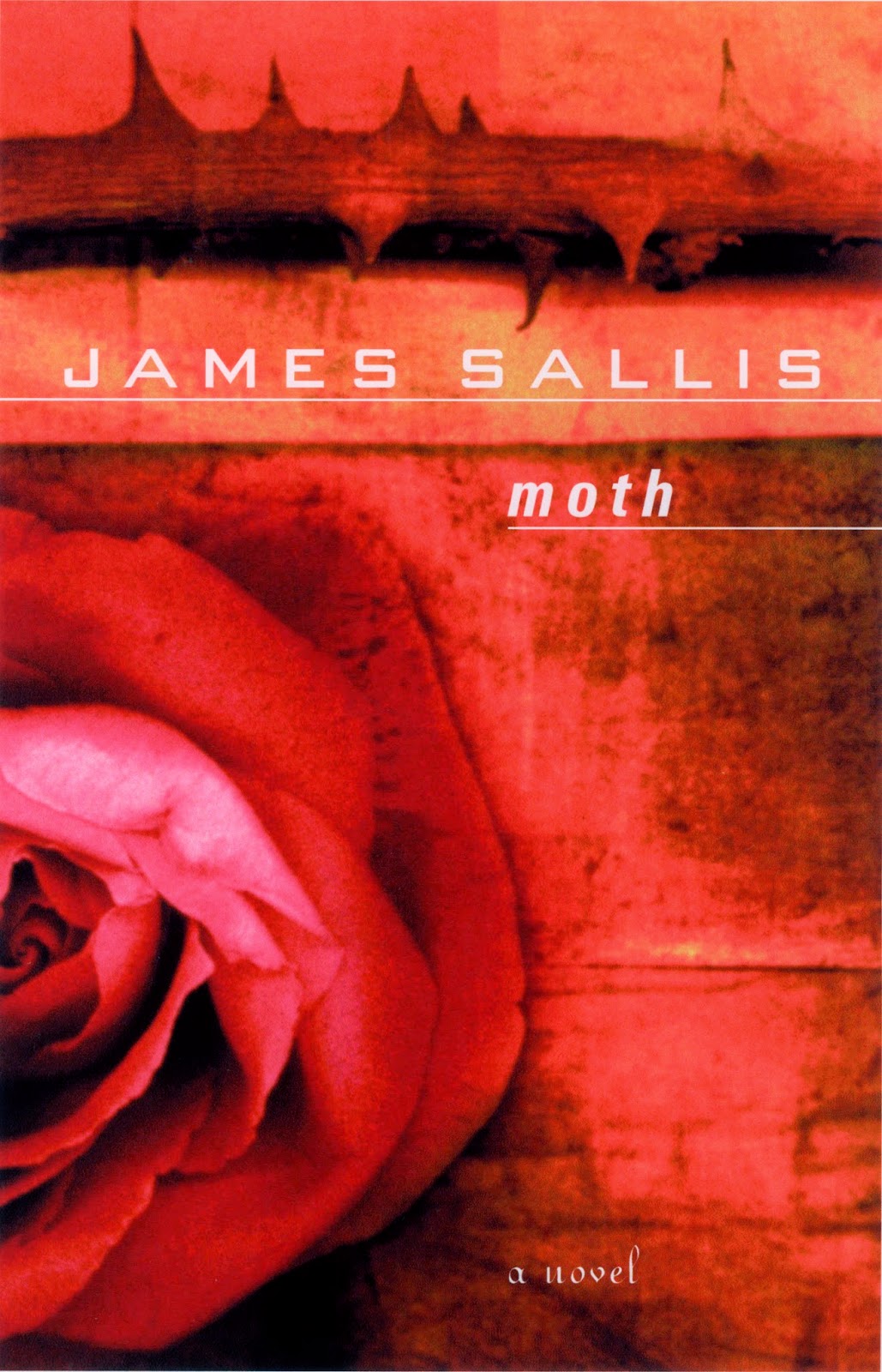
MOTH by James Sallis


GRADE: A-

*Book 2 of the Lew Griffin series*

While the first book in James Sallis's Lew Griffin series, The Long-Legged Fly, was essentially a compilation of stories during different decades in Lew's life, the second, Moth, focuses on the time immediately following the events at the end of the 1990 section of that first book (literally picking up right where the last line in Fly left off). Lew has realized that he's too old to be running the streets now and has quit as a private detective and is now a successful mystery author and college French instructor. After a close friend passes, he feels a responsibility to track down her runaway estranged daughter. But if the investigation itself is the most important thing to you when reading a mystery novel, then you might be disappointed in Sallis's rich work. 

I found this book to be even more enjoyable than the first. Not only because now I'm more familiar with Lew and Sallis's writing style, but also because I'm discovering how meta, self-referencing, and cyclic these novels might be. Here are some examples:

1) Moth starts off with a line that made me return to the last paragraph in the first book with a whole new understanding, as well as more questions! Intriguing.

2) There's a part in this novel where Lew discusses a bad review of his third novel called Black Hornet, which foreshadows Sallis's next book, the third in the series, one that wasn't even written for another couple of years!

3) There's also a scene where Lew interacts with an old Cajun colleague who's also a private investigator named Boudleaux. But wait a minute, the main private eye character in Lew's books is a Cajun named Boudleaux! Hmm...Lew's inspiration perhaps?

Discoveries like these make this novel and the potential for the series really fascinating. And obviously means that it's necessary to read the series in order. But even aside from that, Sallis is a lovely writer with a great knack for characterization and for turning a simple mystery into a deeper look at loss, regret, and responsibility. He's gearing up to be one of my favorite authors and I want to tackle all of his work now. And with this book, the Lew Griffin series is gearing up to be an excellent, detailed character piece. While Fly touched on multiple parts of Lew's life, acting like an outline for Lew's entire story, Moth and the subsequent books seem to expand more on each specific period, adding more detailed nuance and texture to a larger existential portrait of a complex man.
While I never could bring myself to accept Christian notions of sin and atonement, there's definitely something to karma. The things we do pile up on us, weigh us down. Or hold us in place, at the very least.

Tuesday, December 2, 2014

THE LONG-LEGGED FLY by James Sallis


GRADE: B+
 *Book 1 in the Lew Griffin series*

"In the darkness things always go away from you. Memory holds you down while regret and sorrow kick the hell out of you.  
The only help you'll get is a few hard drinks and morning."
This book is unlike any other detective novel I've read. You know how in all detective stories you get the sense that the case our hero is investigating is a stand-out case for him amongst all of his smaller, regular cases? That it's a a mystery that he'll probably remember forever and is worth dedicating a book to above the others? Well, The Long-Legged Fly focuses instead on those OTHER cases: the everyday ones, the day-to-day work. The book can barely be considered a novel; it's more of a series of short stories highlighting key times throughout different decades in Creole private detective (and part-time insurance strong-arm) Lew Griffin's life as an individual instead of just a hard-boiled dick. Even though the mysteries are fairly tame and inconsequential, each decade finds Lew as a different person, a complex man that finds himself and loses himself again, that evolves and transforms throughout the years, as any person would. 
"The world doesn't change, and mostly we don't either, we just go on looking into the same mirror, trying on different hats and expressions and new sets of vice, opinion, and prejudice; pretending, as children do, to see and feel things that are not there."
It's also written by James Sallis, who is not only a crime novelist but also a poet, philosopher, and musician. He fills the book with sometimes drunken but always poignant ruminations on life, the blues, and classic literature. Although the book's structure makes it sometimes difficult to be engaged in the superficial story, the character of Lew Griffin is the star of the show, and it's fascinating watching him evolve. I really enjoyed this one. Sallis is a really gifted writer and I'm interesting in seeing where Griffin goes from here.
"Maybe the best parts of our lives are always over. Maybe happiness, contentment, are things we only recollect through the filters of time, elusive ghosts forever behind us."